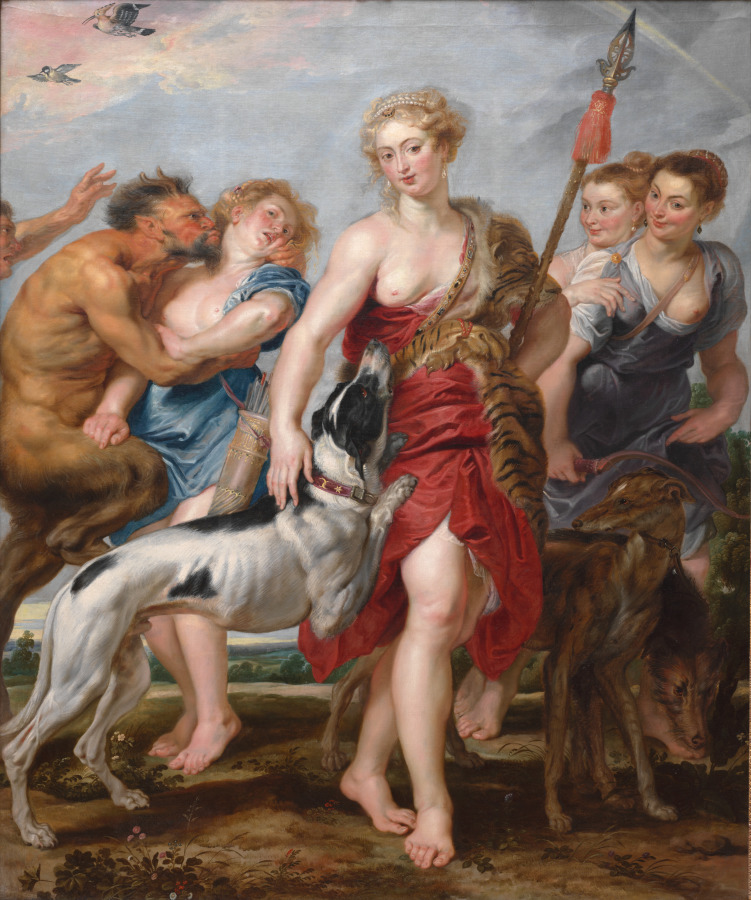
Diana and Her Nymphs Departing for the Hunt
Peter Paul Rubens • 1615 • Cleveland Museum of Art
Diana is a goddess in Roman religion, primarily considered a patroness of the countryside and nature, hunters, wildlife, childbirth, crossroads, the night, and the Moon. She is equated with the Greek goddess Artemis, and absorbed much of Artemis' mythology early in Roman history, including a birth on the island of Delos to parents Jupiter and Latona, and a twin brother, Apollo, though she had an independent origin in Italy. Diana is revered in modern neopagan religions including Roman neopaganism, Stregheria, and Wicca.
In the ancient, medieval, and modern periods, Diana has been considered a triple deity, merged with a goddess of the moon (Luna/Selene) and the underworld (usually Hecate).
Executed in oil on canvas, measuring Framed: 261 x 225 x 11 cm (102 3/4 x 88 9/16 x 4 5/16 in.); Unframed: 216 x 178.7 cm (85 1/16 x 70 3/8 in.), the surface rewards close looking. Peter Paul Rubens builds the composition through layered glazes and a tightly controlled palette, letting cool shadows recede so that the warm, lit passages step forward. The brushwork shifts from the precise to the almost dissolved — a hallmark of mature Baroque practice.
Look closely and the painting opens up. Objects you might pass over — a folded letter, a half-drawn curtain, the angle of a glance — were placed to be read. The iconography draws on scripture and classical myth, but the emotional weight is entirely human.
Today the painting is held by Cleveland Museum of Art in Cleveland, where it remains a touchstone for understanding Peter Paul Rubens's contribution to Western art. It has been studied, copied, restored, and argued over for centuries — proof that great paintings keep generating new readings long after their creators have gone.